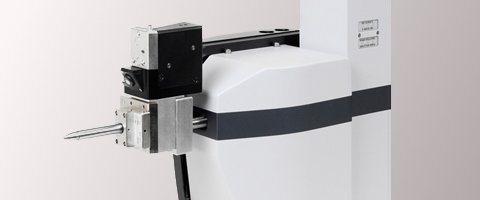
MX multilayer optics
The Ultimate Optics for Protein Crystallography
The MX optics, optimized to deliver even more intensity to the sample is the latest development in Montel multilayer optics. MX stands for "micro crystals", and produces a smaller spot than regular optics. It is available for Cu radiation, and utilizes an improved coating with higher reflectivity.

- more intensity on small samples
- reduce scattering of loop, cryoprotectant, and surrounding air
- less background
The MX optics can be used in combination with both the Incoatec Microfocus Source IµS, or rotating anode sources.
IµS vs. IµS-MX
Measurement: 75 µm Lysozyme (T = 100 K, DX = 42 mm, Dφ= 0.5°, 60 s)
(comparison in the same grey scale)
| IµS | IµS-MX |
 |  |
| |
divergence (mrad)
| 5.1 | 7.6 |
| Focal size (mm) | 0.25 | 0.11 |
| Flux (photons/s) | 3.5 x 10⁸ | 1.4 x 10⁸ |
| Flux density (photons/s-mm2) | 5 x 10⁹ | 1 x 10¹⁰ |
Helios vs. MX
Equipped with the MX optics, a Bruker AXS Microstar generator is turned into the ultimate solution for high-end laboratory protein crystallography. With an intensity of typically 1.6 x 10¹¹ photons/sec-mm2, it is the highest flux density available with home-lab sources. It enables crystallographers to solve crystal structures in-house which up to now has required synchrotron beamtime.
Advantages of the MX when combined with a Microstar